Atmospheric Inputs Driving Live Odds Recalibrations Across Premier League Encounters and National Hunt Races
Henrik Müller · Aug 24, 2026
Atmospheric Inputs Driving Live Odds Recalibrations Across Premier League Encounters and National Hunt Races
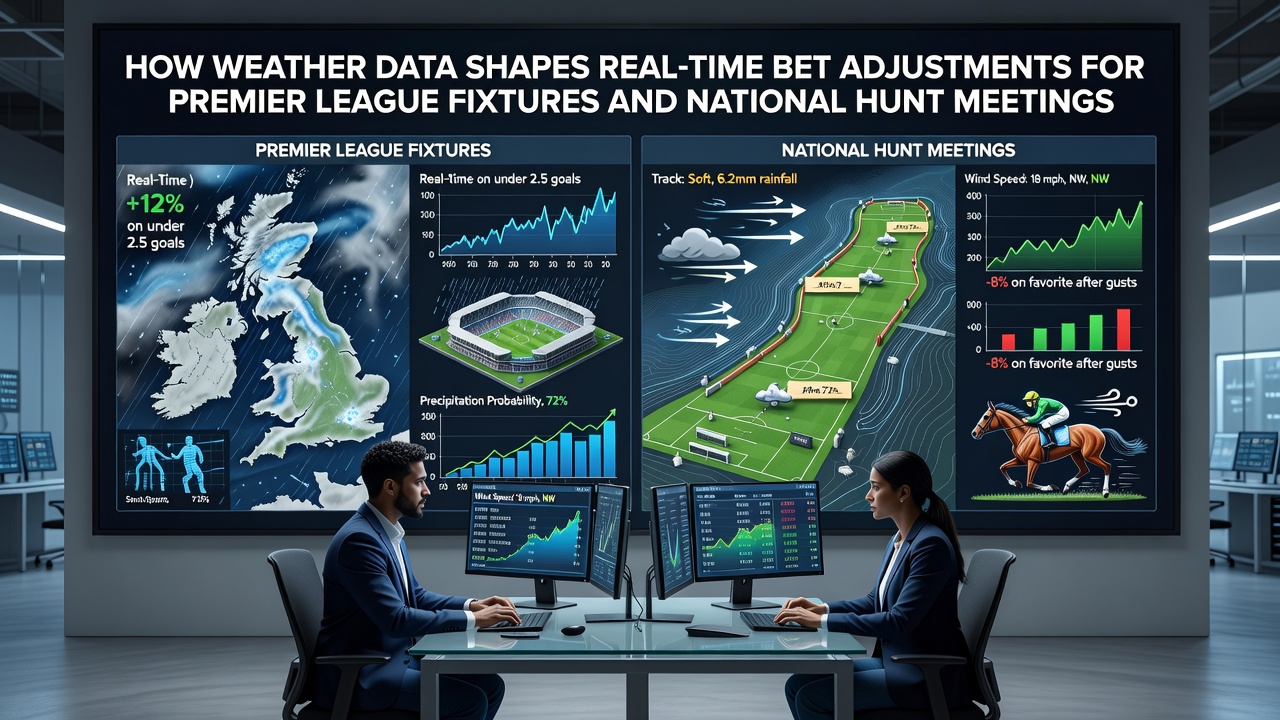
Weather monitoring networks feed continuous streams of atmospheric data into betting platforms that adjust odds for Premier League fixtures and National Hunt meetings while events unfold, and operators integrate readings on rainfall intensity, wind speed, temperature fluctuations plus ground moisture levels to recalibrate probabilities in real time. Data indicates these systems draw from satellite feeds, on-site sensors and regional forecasts that update every few minutes, allowing bookmakers to shift lines on goals, corners, winning distances and place markets as conditions evolve.
Ground Condition Metrics in National Hunt Racing
National Hunt meetings depend heavily on turf state, and precipitation patterns recorded during morning inspections determine whether courses are listed as good, soft or heavy, which in turn alters expected finishing times for chasers and hurdlers. Operators monitor cumulative rainfall over preceding days through automated gauges positioned near each track, and when readings exceed thresholds the algorithms widen margins on favorites while shortening prices on horses proven on softer surfaces. Observers note that sudden showers during an August 2026 card at a northern venue can trigger multiple adjustments within a single race, because trainers report changes in stride patterns once the ground begins to cut up.
Pitch Performance Variables in Premier League Matches
Premier League pitches respond differently to weather because drainage systems, grass types and stadium microclimates create distinct playing surfaces even under identical regional forecasts. Wind gust data collected from anemometers around the ground influences projected pass completion rates and set-piece accuracy, prompting platforms to revise totals on corners and cards when gusts exceed fifteen miles per hour. Temperature drops below ten degrees Celsius correlate with reduced sprint distances in midfield according to performance tracking studies, and betting engines apply those correlations to adjust player props before kickoff and again at half-time intervals.
Integration of Live Feeds into Betting Engines
Betting operators combine radar loops from national meteorological services with proprietary ground sensors to generate minute-by-minute probability matrices, and these matrices feed directly into automated pricing models that recalculate odds without manual intervention. A research paper published by the University of Melbourne's Centre for Sports Analytics examined how wind vectors affect long-range shots in football, finding measurable deviations once speeds surpass twelve kilometres per hour, and platforms now incorporate similar vector data for Premier League venues. Meanwhile, horse racing syndicates supply their own moisture probes that transmit soil saturation percentages every thirty seconds, enabling bookmakers to update each-way payouts when readings cross predefined thresholds during National Hunt fixtures.

Case Examples from Recent Fixtures
Take one August 2026 Premier League match played under building showers where initial over-two-goals odds shortened by eight percent after the first twenty minutes once radar confirmed sustained rainfall across the pitch, and similar adjustments appeared at a National Hunt meeting the same weekend when a late deluge moved the ground from good-to-soft to soft, lifting prices on proven mudlarks while compressing returns on speed horses. Those who've studied these markets observe that the largest swings occur in the opening stages of racing cards, because early runners provide the first empirical evidence that models can validate against sensor readings before further races begin.
Regulatory Context and Data Standards
Industry bodies such as the European Gaming and Betting Association publish guidelines on the use of external data feeds, and these documents stress that weather inputs must originate from verified sources to maintain market integrity. Figures from the Australian Bureau of Meteorology show that cross-referencing multiple stations reduces forecast error by up to twenty-three percent compared with single-source reliance, and operators apply comparable multi-station validation when sourcing data for both football and racing events. The result is tighter spreads on in-play markets once initial volatility settles.
Future Developments in Sensor Networks
Developments in micro-sensor arrays placed directly on playing surfaces and racecourse rails promise higher-resolution readings, and preliminary trials conducted by Canadian research groups indicate that soil temperature gradients measured at five-centimetre depths can predict traction changes up to forty minutes ahead of visible surface effects. Those projections feed into the same pricing engines that already handle rainfall and wind, extending the window during which bookmakers can refine lines before participants notice the shift.
Conclusion
Weather data integration continues to refine how live betting markets respond to atmospheric changes at Premier League grounds and National Hunt venues, with operators relying on layered sensor networks and validated meteorological sources to maintain accurate pricing throughout each event. The combination of ground sensors, radar updates and performance correlations produces adjustments measured in fractions of seconds, ensuring that odds reflect current conditions rather than pre-event assumptions alone.